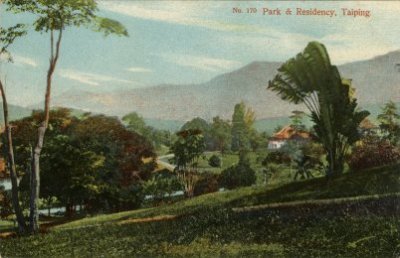
Postcard No. 170, Taiping
太平第170号明信片
An old postcard marked “Park & Residency, Taiping” offers a small, unusually precise window onto the town.
一张印着“Park & Residency, Taiping”的旧明信片,让人看见百多年前太平的一角。
The postcard is numbered 170. In the photograph a grassy rise runs towards a group of trees, with hills behind and a roof almost swallowed by the greenery. That is Taiping according to the caption, not an anonymous country landscape we have conveniently decided to call Taiping. The archive traces the card to publisher A. Kaulfuss of Penang and the Leiden University Library’s KITLV collection, number 1405763. Its recorded date is a range, 1890 to 1930. Nobody should turn that into “photographed in 1900” merely because a round number looks tidier.
The scene is labelled “Park & Residency”, not “Taiping Lake Gardens”. That distinction matters. We can enjoy the old view without pretending to have located the exact camera position. Taiping has enough genuine history; there is no need to manufacture another piece of it with a confident caption. The little card shows how an earlier publisher chose to introduce the town to a distant reader. Not with a hotel room, a breakfast buffet or a map of parking bays, but with trees and a hill.
There is another Taiping story nearby in time, though not necessarily in the same frame. Tourism Malaysia records that the Lake Gardens became the country’s first public recreation park in 1884, on land that had once been a tin-mining site. Think about that change of use. A place from which people had extracted something was turned into a place where the public could simply go. It is an oddly substantial piece of local history to encounter during what looks like an ordinary stroll.
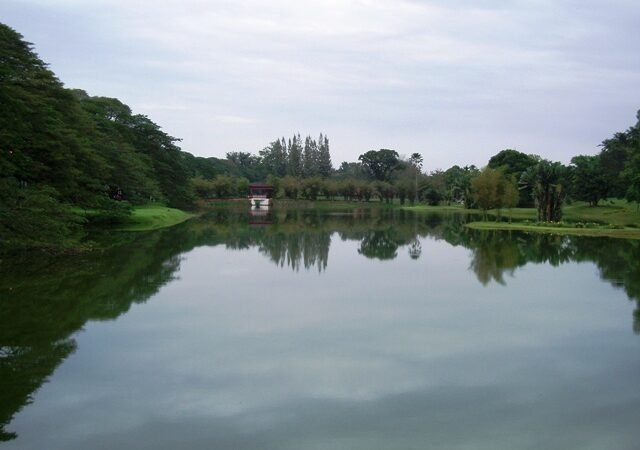
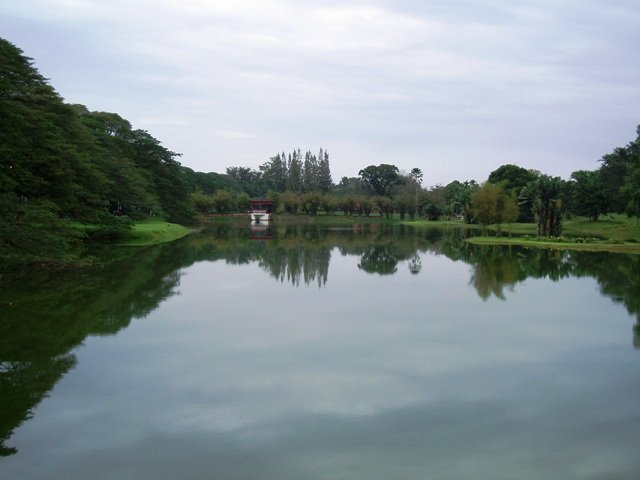
The second photograph here shows the Lake Gardens in a much later era. It was taken in 2007, and released into the public domain by its photographer, Johnwxh30. The views do not match and are not intended as a scientific before-and-after comparison. One is a historic postcard of Park and Residency, the other a photograph of the Lake Gardens many decades later. Together they allow a visitor to compare what people chose to photograph, rather than claim the same tree has been standing in precisely the same place.
An overseas traveller can now study a scene from Taiping’s past before walking into the actual town. There are roads to cross, shopfronts to read, everyday errands to watch, and a fair chance the sky will change its mind about the weather. Those details make a visit different from a postcard. A postcard is very good at keeping a hill in place. It has never had to find shelter when the rain starts.
If you look for the old postcard’s exact viewpoint, treat it as a question rather than a treasure hunt with a promised answer. The archive provides a title and a broad date range, not a set of GPS coordinates. A little curiosity is welcome in Taiping. So are comfortable shoes. You may need the latter long before you solve the former.
Published 15 October 2026
Coming to Taiping to look beyond the postcards? See Sojourn’s rooms or send an advance enquiry. Rooms and rates · Book Direct — advance enquiry
An advance direct enquiry is non-binding. It does not reserve, hold or guarantee any room until Sojourn confirms availability.
Sources and photograph provenance
Leiden University Library / KITLV 1405763 — 1890–1930 historic postcard, public domain · Tourism Malaysia — Taiping Lake Gardens and 1884 tin-mine history · Wikimedia Commons — Johnwxh30, Taiping Lake Gardens 2007, public domain
← Previous← Sebelumnya← 上一篇← 上一篇Next →Seterusnya →下一篇 →下一篇 →